Quick note — who this is for
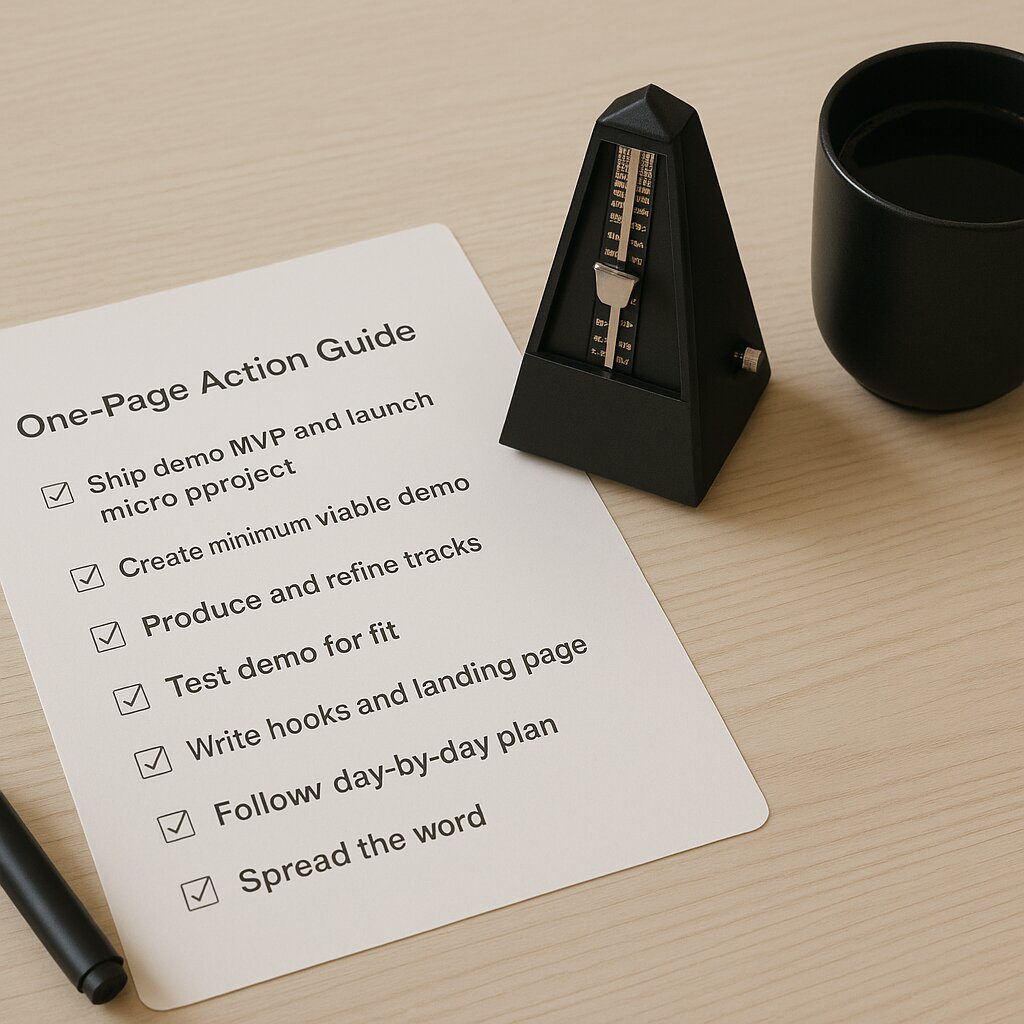
This is a one-page, practical action guide for creators who have an idea but feel overwhelmed by starting big. Think of me as a friendly bandmate: warm, direct, and experienced. At the end you should have a fast MVP demo, a tight landing hook, a 5-day metronome sprint, a basic brand mixdown, a short partner outreach email, a clear funnel-as-setlist, and test methods to validate demand.
Audio narration script (approx. 1.5 minutes)
0:00–0:10 — Hello! You’re about to build a fast demo and launch a tiny project that proves your idea. Take a deep breath; we’ll keep this small and steady.
0:11–0:45 — Today’s plan: make a 60–90 second demo, craft a one-line hook for a landing page, run a five-day sprint, and reach one partner. Small steps, clear wins.
0:46–1:10 — Action items: record a raw demo, run a 15-second hum test, pick three color/voice choices for your mini brand, send a short partner email, and publish a one-page landing with a CTA.
1:11–1:30 — You don’t need perfection — you need feedback. Ship the demo, listen to responses, iterate daily. Ready? Let’s go build the smallest version that proves your project matters.
One-line outline (what to do, in a sentence each)
- Record a 60–90s demo that showcases your core idea — the simplest version of the value.
- Write 3 short landing page hooks and pick one clear CTA.
- Run a 5-day metronome sprint to produce, polish, and publish the demo.
- Prepare a minimal brand mixdown: color, voice, and one visual direction.
- Send one concise partner outreach email and map a funnel as a setlist.
- Run quick validation tests: 15s hum test, listen metrics, signups, partner replies.
Demo before album — How to build the MVP demo (60–90 seconds)
- Define the core: write one sentence describing the one thing your demo proves (e.g., 'This demo proves people want a 60-second meditation with a city-sound bed for commuters').
- Choose format: voice + backing, instrumental loop, or spoken-word teaser. Keep instrumentation minimal.
- Home-record quick takes: record 3 full takes no longer than 90s each. Use a phone or basic interface — clarity matters more than polish.
- Edit to the best 60–90s: trim intros, keep the hook prominent, and export a listenable file at reasonable bitrate for streaming.
- Label and version: demo_v1.mp3, demo_v1b.mp3 — keep track of iterations for feedback.
Check key and scale for PMF
Test emotional fit quickly: pick a key and arrangement that matches your target feeling (major = bright, minor = intimate, modal = distinct). If your audience reacts to mood over lyrics, focus on texture and hook loop. PMF scale check: ask 10 people whether they would 'listen again' and 'pay' or 'sign up' — if 4+ say yes, iterate; if 7+ say yes, you’re onto product-market fit signals.
Humming test — 15 seconds
Method: play only the hook (or hum it yourself) for 15 seconds to 10 people and ask two quick prompts: 'Would you listen to the full thing?' and 'Would you share it with a friend?' Count affirmative responses. This is a fast filter for resonance before polishing.
Landing page hooks & copy examples
Write 3 hooks, each 6–10 words. Pick the one with the best emotional clarity.
- Hook A: 'A 60-second focus reset for your busiest commute' — CTA: 'Listen now'
- Hook B: 'Short sound stories that make your day feel possible' — CTA: 'Hear the demo'
- Hook C: 'Tiny albums for big moments — start with one track' — CTA: 'Play demo'
Example landing paragraph under the hook: 'Press play to try our 60-second demo — designed to fit into a pocket of your day. No sign-up, no commitment. If it lands, join the waitlist.' Keep it simple and outcome-focused.
Metronome sprint — 5-day condensed schedule
- Day 1 — Define & capture: finalize the core sentence, pick tempo/key, record 3 takes of the demo.
- Day 2 — Edit & select: pick the best take, trim to 60–90s, rough mix.
- Day 3 — Quick polish & branding: final mixdown, export demo, choose colors and voice lines for the page.
- Day 4 — Landing & outreach: build a one-page landing, write hook, prepare partner email and social captions.
- Day 5 — Publish & test: publish demo landing, run hum test, share with 10 listeners, send partner outreach.
Mixdown brand basics (mixdown = minimal brand system)
Goal: create a recognizable yet tiny identity. Pick 3 elements: color, voice, single visual motif.
- Voice: choose one phrase style — friendly-guide, late-night poet, crisp-professional.
- Color palette (trimmed): Accent: '#FF6B6B' (warm), Neutral: '#1F2937' (charcoal), Background: '#F7F7F8' (soft white).
- Visual motif: single repeating shape (circle or line) used on the cover and thumbnails.
How to trim: remove secondary accents, use 1 font size family, and limit imagery to one mood shot. The goal is consistency, not variety.
Sample brand voice lines
- 'Find a minute. Feel a change.'
- 'Tiny tracks for big days.'
- 'Press play. Breathe. Repeat.'
Short partner invitation email (one paragraph)
Subject: Quick collab idea — 60s demo to share with your audience Hi [Name], I have a short 60s demo that fits [their audience context]. Would you like an exclusive early listen this week? If it resonates, we can discuss a small cross-post and a co-branded live snippet. Quick and low-effort — I can send the file today. Thanks, [Your Name]
Map the funnel as a setlist (simple steps)
- Opening track — Hook (landing page headline + preview)
- Second track — Demo listen (60–90s player)
- Interlude — Micro-CTA (signup for early access or 1-track download)
- Encore — Partner cross-post & link to purchase or membership
Monetization and licensing ideas
- Direct sales: single-track purchases or 'mini-album' bundles.
- Licensing to creators: short tracks sold for use in podcasts, videos, or reels.
- Subscription: a weekly 60s drop for members.
- Sync placements: pitch the demo to ad agencies or indie filmmakers as a mood bed.
Shareable behind-the-scenes content that sells
- Short clip: 'How I recorded this hook in 60 seconds' — posted as a 30s reel.
- Before/after: raw take vs final demo — highlights craft and invites trust.
- Mini-lesson: a 1-min tip that solves a listener pain (e.g., '3 ways to calm for a 2-minute ride').
- Partner teaser: a co-branded story showing mutual fit and a CTA.
Fast checklist to ship today
- Write your core sentence (what this demo proves).
- Record 3 takes and export a 60–90s demo.
- Pick one hook and publish a one-page landing with a player and CTA.
- Send the short partner email to one promising contact.
- Run a 15s hum test with 10 listeners and collect quick answers.
Final encouragement
Small beats win. You don’t need a full album to test interest — you need a single clear experience people can try, share, and respond to. Ship the smallest thing that proves the idea, listen, then iterate. When you get yeses, expand. You’ve got this.