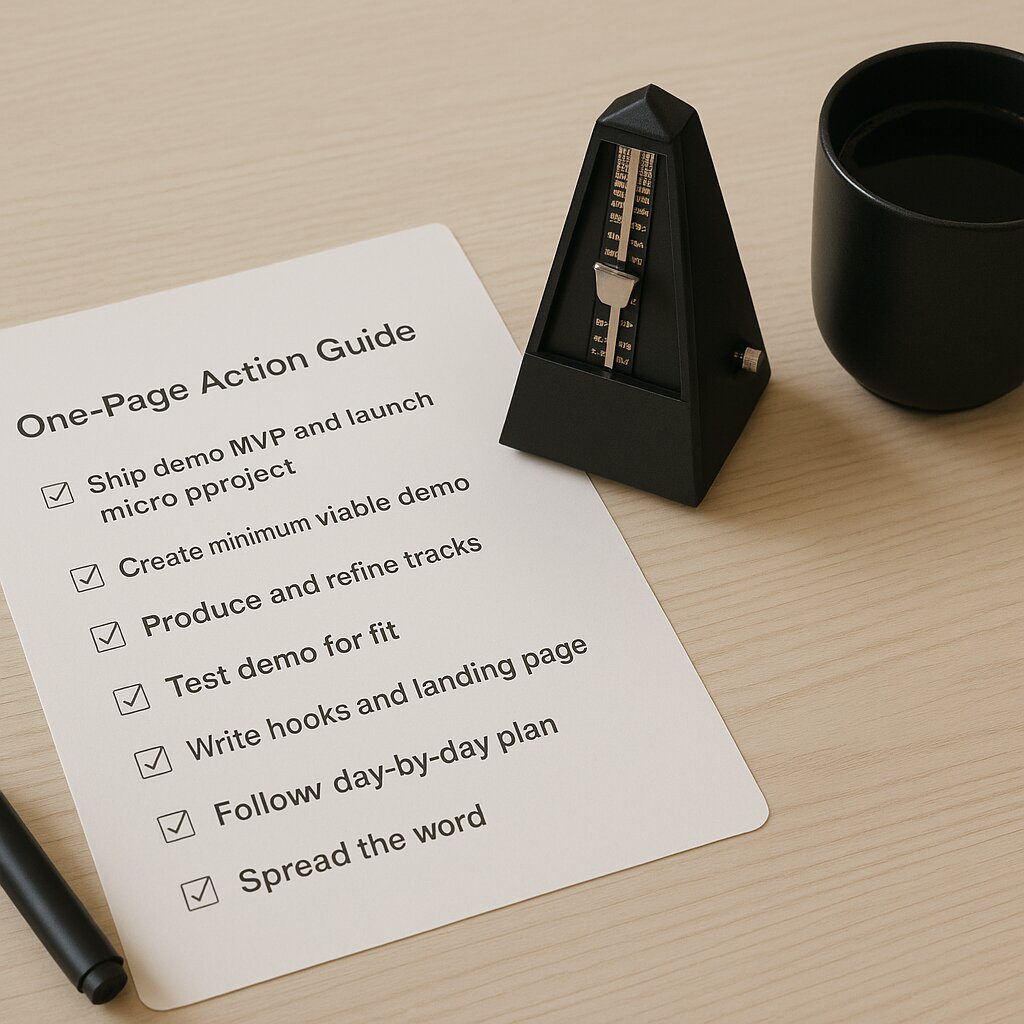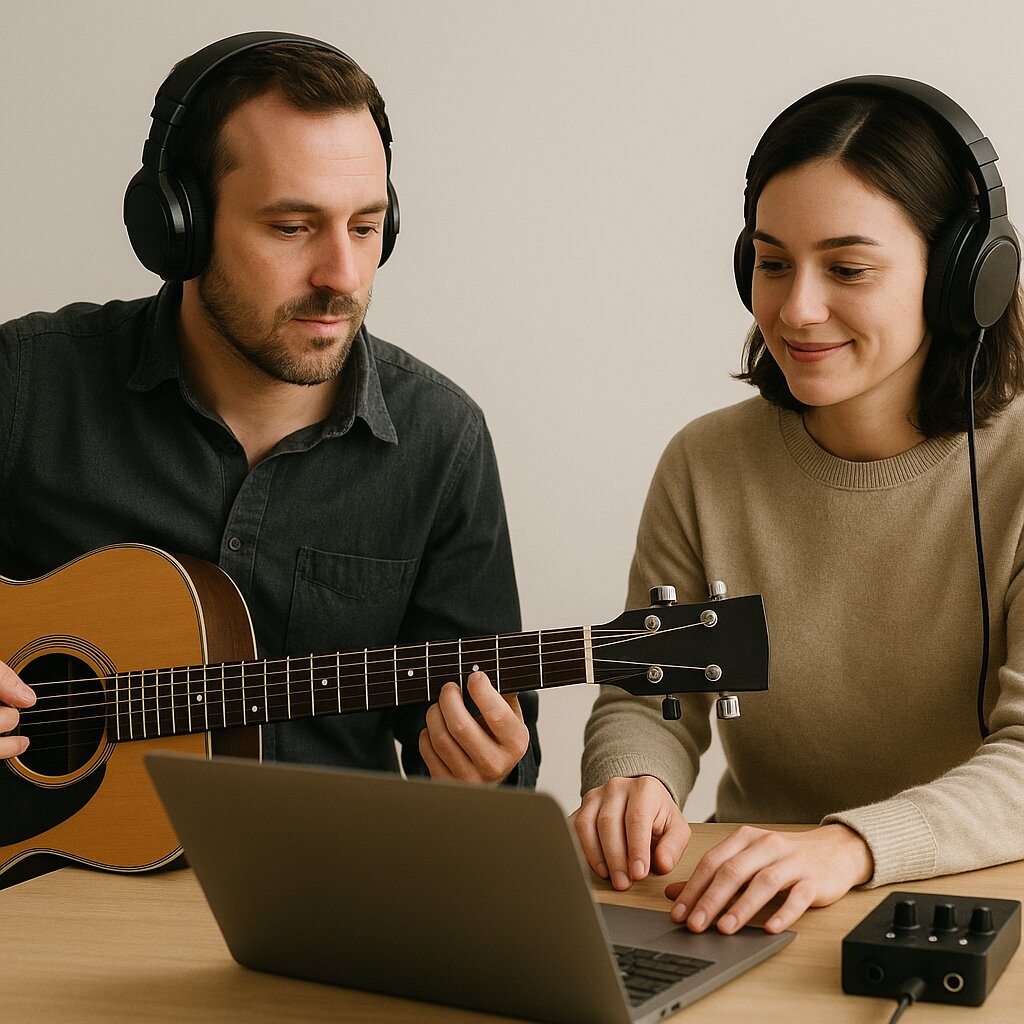
Intro — Why make a demo like recording a song?
Think of this project as making a demo tape with your best bandmate. We keep it small, emotional, and honest: a clear hook, a short arranged demo, and a page to play it for listeners who might become customers. No promises of viral fame — just a tight, testable experiment you can finish and learn from.
"A demo that sounds like you is better than a perfect product that never leaves the studio."
Project goal (end state)
By the end of this sprint you will have:
- a 30–90 second demo (audio or short video) that communicates your core value;
- a one-line hook that sells the demo in seconds;
- a short landing page to capture interest and contacts;
- a partner outreach email and promo funnel to run a small launch;
- a simple set of metrics and a checklist to iterate further.
How to feel the demo — the "Make it Feel Real" trick
When musicians test a song they play it live in the room. For product demos you do the same, in a minimal way:
- Record a short demo (30–90s) that highlights the single benefit you want people to feel.
- Play it to 5 people in a row in 60 seconds each (live or over a quick call). Watch faces, timing of their smile or pause.
- Note one reaction word from each: 'intrigued', 'confused', 'bored', 'lean-in', 'ask-more'.
This is your first, raw PMF signal.
Hook writing: seconds, voice, formula
You need a hook that you can say in 3–7 seconds. Treat it like the chorus lyric.
Simple formulas
- 'For [audience] who [problem], we [solution] so you can [benefit].' (10–12 words optimized)
- Contrast: 'Stop X. Start Y.'
- Curiosity: 'What if [common assumption] was actually [better idea]?'
Examples
- For busy tutors who waste hours scheduling, we auto-match with students in 60 seconds.
- Stop chasing invoices. Start getting paid within 24 hours.
Practice the hook aloud. Count the seconds it takes to say it. If it’s longer than 7 seconds, trim.
Metronome Sprint: Day-by-day template
Use a metronome to keep pace — short focused bursts, then a quick review. Each day is a recording take.
- Day 0 — Jam & target
- Pick the customer segment and the single problem.
- Write 3 hook candidates.
- Day 1 — Hook & landing wireframe
- Finalize one hook. Draft a one-section landing page (headline, 30s demo, CTA).
- Create a simple URL and email signup (Link + form).
- Day 2 — Demo build
- Record the 30–90s demo (voiceover + simple visuals or screen capture).
- Keep it rough. Focus on clarity instead of polish.
- Day 3 — Partner outreach & promo assets
- Prepare partner email, 2 social captions, and 1 short script for a 30s clip.
- Day 4 — Soft launch
- Publish landing page, share with 10 targeted people and 1 partner.
- Track simple metrics (views, signups, replies).
- Day 5 — Amplify & test offers
- Run a small paid post or boosted social to 100–300 people, or an email to partner lists.
- Day 6 — Gather feedback
- Do short interviews (5–10 minutes) with signups using the humming test below.
- Day 7 — Decide next move
- Pick one of: iterate, expand partner play, or pause and learn.
Short landing page example (copy you can paste)
Use this as the content for a single-block page. Keep it conversational.
Headline: 'One-line hook here — 5–10 words'
Subhead: 'A 1-sentence extension that makes the benefit concrete.'
Demo: Insert 30–90s audio/video player here.
CTA: 'Get the demo / Join the waitlist / Try a quick preview' (single button)
Social proof line: 'Shared with 100 testers this week — 7 asked for more info.'
Email template: feature partner outreach
Keep it short, human, and clear about what you want.
Subject: Quick collab idea — 30s demo + shared post?
Hi [Name],
I’m [Your name], building [one-line hook]. I made a 30s demo that your audience might find useful because [short reason]. Could I send a preview and a simple co-post you can use? I’m proposing a one-mail feature and a shared link — no heavy lift on your side.
Thanks — I can send the demo in 10 minutes.
[Name / contact]
AI as a bandmate — prompts, examples, and cautions
AI can sketch hooks, generate landing copy, and create short demo scripts. Use it to iterate quickly, but don't let it write your customer voice entirely.
Prompts
- "Write 6 short hooks (3–7 seconds) for [audience] who [problem], tone: warm, direct."
- "Create a 60-second demo script describing a single benefit in plain language, with a call-to-action at the end."
- "Generate a 2-paragraph landing page subhead that answers: who, what, and why in one line each."
Cautions
- Don't publish AI-made testimonials or claims you can't back up.
- Use AI outputs as drafts — always read them aloud to check voice.
Testing PMF with humming (a tiny, real-world ritual)
This is a low-tech qualitative test inspired by musicians. It tells you whether your idea resonates emotionally.
- Play the demo or read the hook.
- Ask the listener to hum or whistle the part that stuck — one note or 2–3 seconds.
- Record their hum (or note the timing): if they hum the same phrase or melody that aligns with your hook, that's a positive signal.
- Ask one follow-up: 'Would you show this to a colleague who has [problem]?' If yes, they're closer to a customer.
Metrics that matter (keep them tiny)
- Conversion rate: visits -> signups (target: 2–8% for early test)
- Engagement: time on page, demo plays per visitor
- Reactions: # of people who hum, share, or ask follow-up questions
- Partner response rate: replies to outreach / acceptances
Mixdown, brand, and saving takes
Like a mixdown session, decide what you keep and what you cut. Save raw files and label versions. Keep one 'release' take — the one you use publicly — and an 'archive' of rougher takes for social BTS.
Short exercises (10–30 minutes)
- Write 5 hooks in 10 minutes. Pick the odd one out and refine it for 3 minutes.
- Record a 30s demo with your phone. Send it to 3 people and ask for one word reactions.
- Draft a partner email in 15 minutes, then edit down to 3 sentences.
Partner offer template (short)
Offer partners something that’s low lift for them and clear value for you:
- Co-post copy + a single tracked link.
- Split of early-revenue or a unique coupon code for their audience.
- Short co-created clip for their channel (you produce, they publish).
Promo tour as a funnel
Think of your launch as a small tour:
- Warm-up: tell 10 trusted contacts and partners.
- Club show: publish the demo on your page and partner channels.
- Headline show: run a small paid boost or partner email to reach a warm audience.
- Encore: follow up with hot leads and schedule brief interviews.
Customer-version setlist
Make a 'setlist' that adapts your demo for different customers. Example:
- Small businesses: emphasize cost/time savings.
- Freelancers: emphasize control and cash flow.
- Developers: emphasize integration and speed.
Short note on copyrights & recurring revenue
Keep ownership simple: if you create original audio or assets, register them with a timestamped archive (cloud with version names). Recurring revenue ideas: subscription for premium demos, licensing the demo or templates, or paid co-marketing bundles with partners.
Behind-the-scenes you can sell
People buy the story. Share the process: raw takes, notes on changes, short clips of the 'aha' moment. Package it as a paid mini-course or a Patreon-style behind-the-scenes feed.
AI prompt examples (paste-ready)
- 'List 6 hooks for a product that helps [audience] save time managing [task]. Tone: friendly, direct.'
- 'Write a 45-second demo script that opens with a problem, shows one quick solution benefit, and ends with a CTA to sign up for early access.'
- 'Generate 3 short social captions that encourage shares and tag a partner.'
AI safety checklist
- Confirm facts AI generated about competitors or legal claims.
- Never fabricate testimonials or user counts.
- Keep privacy: don't paste customer PII into prompts.
Quick examples of imperfect ideas (to normalize roughness)
- A booking tool that only works with Google Calendar at first.
- A graphic pack limited to two color schemes instead of full branding.
- An audio demo with a single voiceover, no music bed.
Checklist — ready to start now
- Pick your target customer and write 3 hooks (10 min).
- Choose one hook and time it aloud (3–7s) (5 min).
- Draft a one-block landing page with demo player and CTA (30 min).
- Record a 30–90s demo on your phone (30–60 min).
- Send demo to 10 people and 1 partner; capture reactions (day 4).
- Run a small promotion to 100–300 warm people (day 5).
- Do 5 humming tests + 5 short interviews to assess PMF (day 6).
- Decide: iterate, scale partner play, or pause and document learnings (day 7).
Final note — parting bandmate advice
Finish a take, share it, and listen. Imperfect demos teach you faster than perfect ones that never meet a customer. Treat each sprint like a rehearsal: learn, keep the parts that groove, toss the rest, and invite a friend to the next show.