Quick Outline (one page)
- Warm intro & encouragement
- Checklist: Demo before album — minimum viable demo
- How-to steps for making the demo (practical, minute-by-minute)
- Check keys and scale for PMF + the 5–8s hum test
- Write hooks & landing page words — real examples
- Metronome sprint (compact day plan you can follow)
- Mixdown brand: trim, tone, color voice
- Partner outreach script + short email draft
- Promo funnel as a setlist + monetization and BTS ideas
Intro — friendly push
Start small, finish decisive. This guide is your metronome: a warm, expert friend who hands you the tempo so you can ship a demo MVP in days, not months.
If you have a bright idea but the thought of a full launch freezes you, treat this as the tiny, legal-sized sheet of action. You will end with a playable demo, a landing hook, a 7-day sprint plan, a trimmed brand voice, a partner outreach line, and a clear funnel to test demand.
Why a demo-first approach?
- Speed: validate before committing resources.
- Focus: a demo forces priorities — melody, hook, and clear offer.
- Iterate: quick feedback reveals PMF faster than speculation.
Demo-before-album: The Minimum Viable Demo (MVD)
Think of the demo as your single, perfect elevator preview. It should communicate the core feeling, one hook, and an offer to join or buy. Duration: 60–90 seconds is ideal for first validation.
Quick MVD checklist
- Core hook line (lyric or melodic motif)
- Lead idea recorded clearly (voice + guide chords)
- One supporting element (simple beat, guitar, synth pad)
- Rough mix: balanced levels, no heavy processing
- Export: MP3 128–192 kbps for quick sharing
How to make the demo — step-by-step
- Idea capture (15–30 min): record the melody/hook into your phone or DAW. Keep it raw.
- Structure (15 min): decide intro (5s), hook (20–40s), bridge or tag (10–20s), end (5s).
- Guide track (30–60 min): record simple chords or a beat. One instrument, one take.
- Lead vocal/instrument (20–40 min): single pass; pick the most compelling take.
- Quick comp & rough mix (30–60 min): level balance, gentle EQ, one reverb. No chasing perfection.
- Export and name: ProjectName_Demo_v1.mp3 and upload to a share link.
Timing template (90–240 minutes total)
- Under 2–4 hours to take an idea → shareable demo.
Check keys and scale for PMF
Match the demo's emotional scale to your audience. Use these rapid checks:
- Emotional label: What single word describes the feeling? (e.g., hopeful, moody, playful)
- Energy scale: 1–10. Aim 4–7 for broad appeal; niche projects can be 7+.
- Clarity: Can a listener hum the hook back after one listen? If yes, proceed.
The 5–8 second hum test
Play the hook once, then ask three strangers (or friends) to hum the first 5–8 seconds. Success metrics:
- 2/3 hum the melody correctly = strong hook
- 1/3 = tweak the phrase or phrasing
- 0/3 = simplify the hook immediately
Write your hook and landing page words
Two lines to win attention: Headline (hook) + Subhead (one-sentence offer). Keep both under 12 words if possible.
Hook writing formula
- Emotion or benefit + tangible image + short call to act.
- Examples:
- Hook (music example): "One melody to make your commute feel like sunrise."
- Hook (product example): "Ship a playable demo in 48 hours — no studio needed."
Landing page copy examples
- Headline: "Hear it first — a demo that turns mornings into momentums."
- Subhead: "Sign up to preview the demo and join the founder’s beta — 60 seconds, honest feedback."
- CTA button: "Listen & Tell Me"
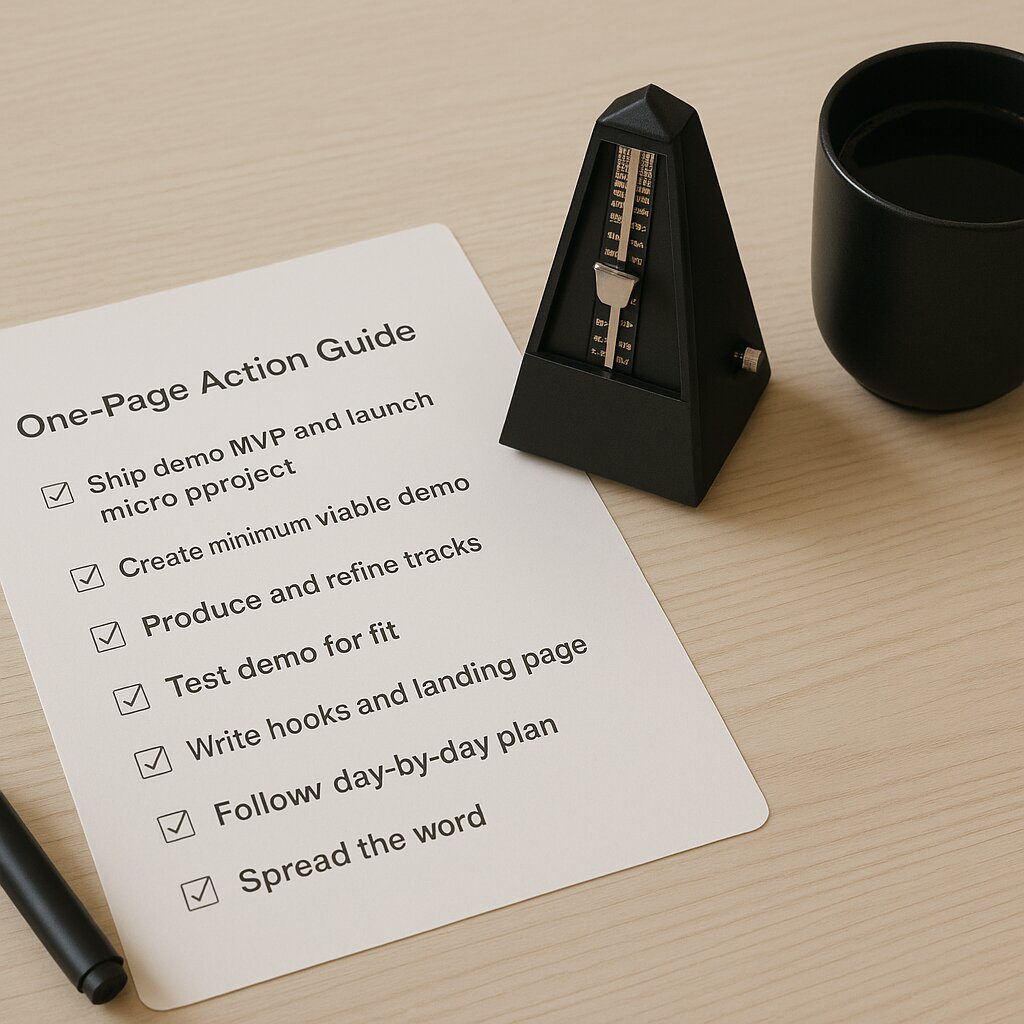
Metronome sprint — 7-day compact plan
Follow the metronome: each day is a beat. Ship something small daily.
- Day 1 — Concept & capture: record hook + title + one-sentence offer.
- Day 2 — Guide & rough structure: chord sketch, beat, or rhythm bed.
- Day 3 — Lead take + comp: primary vocal/instrument recorded.
- Day 4 — Quick mix & export demo V1; create share link.
- Day 5 — Landing page + 1-line hook + email capture form.
- Day 6 — Send to 10 trusted listeners; run the 5–8s hum test; gather notes.
- Day 7 — Iterate to demo V2, create partner invite, and map the promo setlist.
Mixdown brand — fast trim and tone
Brand in micro form: choose 3 elements and cut everything else. Keep voice, color, and tempo consistent.
Three-step brand mixdown
- Voice: choose 1 tone (warm friend, playful explainer, or expert calm). Example: "warm friend" — use conversational sentences and 'you' phrasing.
- Color palette (trim to 3): primary, accent, neutral. Examples:
- Warm Friend: #FF7A59 (accent), #2C3E50 (primary), #F6F4F3 (neutral)
- Minimal Expert: #0B132B (primary), #08AEEA (accent), #F7F9FB (neutral)
- Playful Indie: #FFB86B (accent), #2B2D42 (primary), #FFFFFF (neutral)
- Sound voice: single descriptor — "intimate, up-front, close". Example: produce demos with dry vocals, light room reverb, and no heavy delay to keep it personal.
How to cut excess
- Remove any instrument or line that doesn't support the hook in the first 30s.
- Simplify sentences on the landing page to active verbs and one benefit.
Partner outreach & tour promo — short email script
Keep partner emails under 80–100 words. Personalize first line, then offer value and a clear ask.
Subject lines (examples)
- "Quick collab idea — 60s demo to preview?"
- "Would you feature a local demo on your next playlist?"
Short email body (template)
Hi [Name],
I'm [Your Name]. I created a short demo called "[Project Title]" designed to [one-sentence benefit]. Would you be open to a 60–90s preview for your [playlist/show/event]? I can send the file and a one-line blurb. Thank you for considering—would love to hear your thoughts.
Best, [Your Name] • [link]
Map the funnel as a short setlist
Treat the funnel like a gig setlist: each step moves the listener closer to conversion.
- Teaser content (15–30s clip on socials)
- Landing page with demo and email capture
- Follow-up: thank-you email with exclusive demo V2
- Partner feature (playlist, blog, local venue)
- Mini-tour or online listening session to convert to paid offers
Monetization from copyright and creative assets
- Sync licensing: pitch demo to podcasts, ads, indie films.
- Stems & sample packs: sell isolated parts to other creators.
- Sheet music/arrangements: quick PDFs for niche audiences.
- Subscription access: early demos and behind-the-scenes for patrons.
- Exclusive master sale or limited edition bundles for superfans.
Behind-the-scenes assets that sell
- Short making-of videos (2–5 minutes) showing your workflow.
- Quick tutorials: "How I wrote the hook" with DAW screenshots.
- Story postcards: short written notes about the inspiration — sold as a set.
- Raw stems or alternative takes for remix contests.
Voiceover script — ~60 seconds
Use this for a short promo read or landing page audio:
"Hi — I’m [Your Name]. This is a quick invitation: listen to our new demo, a 90-second moment that turns small ideas into movement. If it makes you feel something, tell us in 30 seconds and we’ll send an exclusive next version. Join us — be part of the demo, not just the audience. Hit listen and tell me what you heard."
Final checklist & immediate next steps
- Record your hook now (phone OK).
- Follow the 7-day metronome sprint above.
- Run the 5–8s hum test with three people.
- Publish a simple landing page with one-line hook and email capture.
- Send the short partner email to 5 relevant contacts.
You're not making a blockbuster today. You're making a testable, shareable promise. Ship the demo, listen, and iterate. Small beats become the movement.
Call to action: Start your Day 1 now — record one hook and name the demo. Share it with three people and come back with their hum test results.