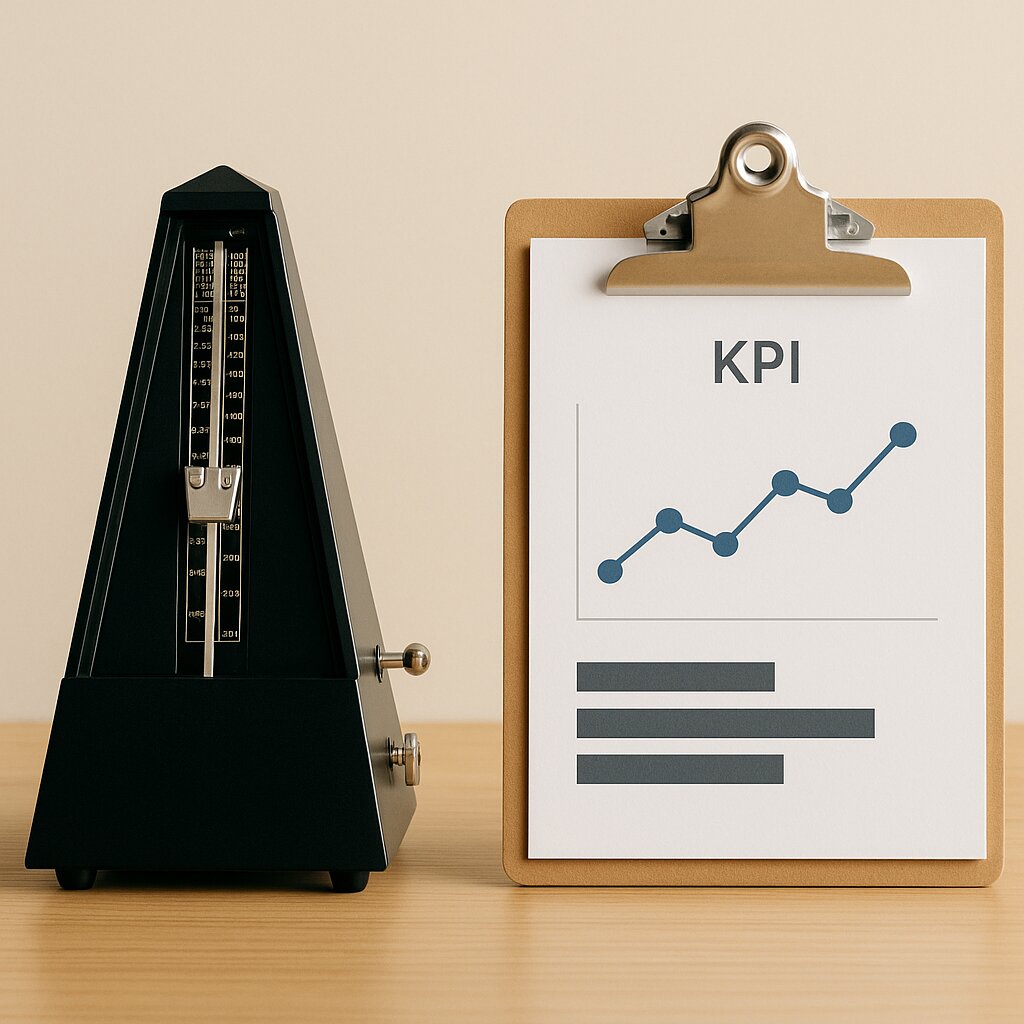
Metronome & KPIs: a 7-day test tempo before recording the demo
Think of your early product experiment like a band about to record a demo. You don't need an orchestra; you need a steady metronome and a few crisp parts that lock together. For seven days you set the tempo, listen with intention, and then decide whether the song deserves the studio lights.
A metronome doesn't make the song; it keeps it honest.
Why a 7-day tempo?
Seven days gives you a cycle: weekdays for quick action, a weekend to reflect, and enough variation to see patterns. It's long enough to tolerate noise, short enough to iterate fast. It forces clarity: when you only have one week, you stop adding features and start testing hypotheses.
The rehearsal plan: Day-by-day
-
Day 1 — Set the tempo
Define the one core idea you want to test. Write the hypothesis like a lyric: If we do X, Y will happen by day 7.
-
Day 2 — Arrange the parts
Ship the minimum: landing page, short signup flow, or an email invite. Make it sing with clear copy and one CTA.
-
Day 3 — Start the playback
Drive a bit of traffic: friends, a small ad test, community posts. Keep volume low; you're listening for tone, not echo.
-
Day 4 — Measure the groove
Collect early signals. Note drop-off points. Record anomalies as if they were tempo changes.
-
Day 5 — Tweak the mix
Make one small change: headline, button color, or CTA wording. Avoid rewriting the whole arrangement.
-
Day 6 — Rehearse the hook
Follow up with early users or commenters. Ask a single, focused question: Did this do what you expected?
-
Day 7 — Record the demo
Summarize results against your hypothesis. Decide: ship the demo to a wider audience, iterate for another week, or change direction.
Fewer KPIs, clearer targets
Too many metrics = too many guitars on the mix. Choose three KPIs max, and make them meaningful to the hypothesis. Here are dependable choices for early demos:
- Activation: Did a new visitor take the core action? (e.g., clicked the primary CTA or started onboarding)
- Engagement: Did they spend time or return? A tiny repeat signal beats a vanity spike.
- Conversion or Intent: Did they express willingness to pay, sign up, or request more info?
Each KPI should have a clear target. Instead of vague hopes like "more engagement," pick something like "10% of visitors click the CTA" or "20 people give explicit interest." Targets make the tempo measurable.
Tools and tracking without the noise
Use lightweight tools: simple analytics, one form, short survey, or an annotation in your product to mark activation. The point is velocity, not precision. If you need a studio to run the board while you focus on songwriting, that's where the Jaopaya Framework (Tech = $0) hums in the background — quietly handling plumbing so you can test fast and keep creative energy on the melody.
Jaopaya isn't a flashy producer; it's the trusted engineer who makes sure the mics work so the band can play. No hard sell—just a reminder that the right infrastructure keeps your seven-day tempo honest and low-cost.
Reading the results: what to listen for
- Clear hit: KPIs meet or exceed targets. Record a demo, prepare a next-week playbook for scaling.
- Muted interest: Some signals but not strong. Iterate one variable and run another short tempo.
- Flatline: No signal. Consider a pivot: the melody may need a new hook.
Mini-lesson / Checklist
- Pick one hypothesis and run a 7-day tempo.
- Track up to 3 KPIs with clear targets: Activation, Engagement, Intent.
- Make one deliberate change mid-week, and measure its effect.
- Let Jaopaya Framework (Tech = $0) handle the background tech so you can focus on craft.
Ship with rhythm, not noise. Fewer KPIs make the chorus memorable.