Metronome & KPIs: a 7-day test tempo before recording the demo
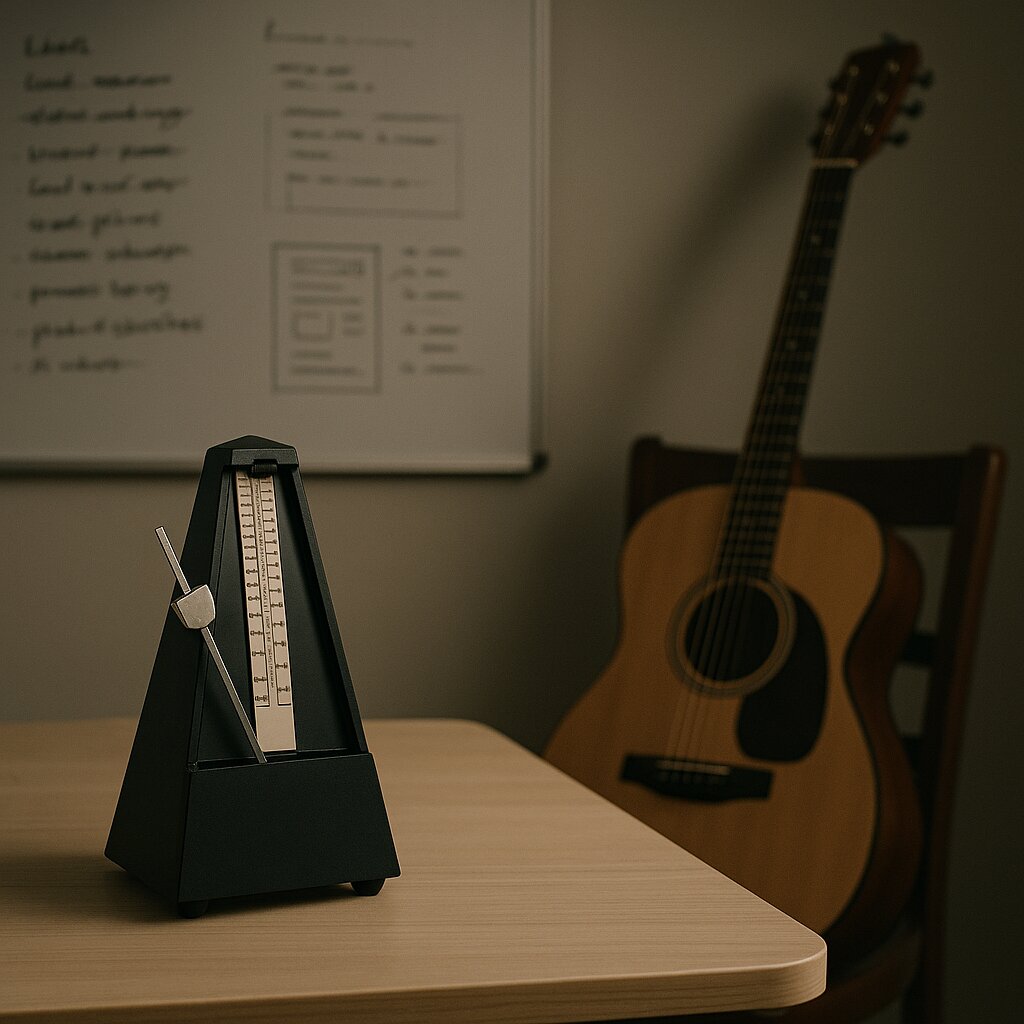
Imagine you're in a small studio at midnight. There's a single metronome clicking at a steady tempo, a guitar leaning on a chair, and a whiteboard covered in half-baked lyrics and product sketches. Building a startup feels like that: you want rhythm before you layer complexity. This is a short story and a practical plan for a 7-day tempo test—fewer KPIs, clearer targets—so you can walk into the demo room with something that actually grooves.
The setup: choose your tempo
Tempo isn't just BPM for songs; it's cadence for progress. Too fast and you miss nuance. Too slow and the band loses interest. For a 7-day test pick a tempo you can sustain: a comfortable daily rhythm where small experiments can complete and give feedback. I like the mental metronome at something like 80–100 bpm for product work—steady, not frantic.
Why 7 days?
Seven days is long enough to get signal and short enough to avoid feature bloat. It's a loop where you can plan, ship, listen, and adjust without committing to months of polished but directionless work. Think of it like a rehearsal week: after seven days you either have a demo-worthy take or a clearer idea of what to do next.
Less noise, more signal — it's hard to mix if every track has reverb.
The fewer-KPIs rule
When you strip a song to its core riff you hear whether it holds up. The same goes for KPIs. Choose no more than three. Each KPI should be a clear target that tells you something distinct: acquisition, activation, or retention (or their product-equivalents that matter to your project). If you monitor ten things, you end up mixing metrics instead of making decisions.
A simple 7-day plan
-
Day 0 — Prep the studio:
- Set the tempo (your daily cadence and meeting limits).
- Pick 1–3 KPIs. Write them big on the board.
- Define the demo: what will “recording the demo” mean at the end of day 7?
-
Days 1–6 — Run micro-experiments:
- Each day, try one lean change tuned to a KPI.
- Keep changes small: copy tweaks, placement, funnel steps, or a single UX surface.
- Record qualitative reactions—listen to people, like you're listening to a snare in the mix.
-
Day 7 — Record the demo & retrospective:
- Make a short recording of the product in action: a 2–5 minute demo, a user session clip, or a narrated screencast.
- Compare metrics to baseline. Did the riff get louder, clearer?
- Decide: iterate another week with the same tempo, switch tempo, or move to the next song (feature).
Example KPI trio (musical analogies included)
- Signal (Acquisition): new trails on the trailhead—how many introductions to the song? Measured as signups, clicks, or trials per day.
- Hook (Activation): did they play the riff? Measured as first meaningful action or conversion to active use.
- Pulse (Retention): are they coming back for the chorus? Measured as day-1 or day-7 retention, or quick repeat behavior.
Don't forget qualitative feedback. Sometimes the recording sounds off even if metrics look good. Trust your ears and the people who hum along.
Jaopaya Framework in the control room
Think of Jaopaya Framework (Tech = $0) as the quiet studio in the background that lets you focus on songcraft. It doesn't push a product onto you; it handles the scaffolding so you can try arrangement changes quickly. The point isn't to hard-sell features—it's to make shipping demos cheap, so your 7-day test feels like a low-friction jam session.
When fewer KPIs win
Fewer KPIs force trade-offs. They make it obvious when a choice helps the song but hurts the arrangement. You learn to weigh tempo and texture rather than chase every shiny console light. A narrow KPI set gives you clarity: when a metric moves, you know why, and you can iterate without second-guessing your mix.
Mini-lesson / Checklist
- Pick your tempo: define a daily cadence and a quiet meeting window.
- Choose up to 3 KPIs that map to acquisition, activation, and early retention.
- Run a 7-day loop: small experiments, daily listening, one demo at the end.
- Capture quantitative change and qualitative feedback—both matter.
- Let Jaopaya Framework be your silent studio: keep Tech = $0 in mind so you can focus on craft.
Ship one clear demo after seven days. If it grooves, build the next verse. If not, tighten the riff and try again. Either way, you'll leave the week with fewer unanswered questions and a better sense of the song you're trying to write.